I finally updated the template (which had disappeared) on my new blog and will attempt (again *ahem*) to keep it updated. Check it out! Thanks for everyone's support!
Showing posts with label Rescue. Show all posts
Showing posts with label Rescue. Show all posts
Monday, October 11, 2010
Check It Out
I finally updated the template (which had disappeared) on my new blog and will attempt (again *ahem*) to keep it updated. Check it out! Thanks for everyone's support!

Wednesday, January 13, 2010
HAY you guys!!!!
Attention fellow horse-bloggers!! Help out NorCal Equine Rescue for free AND get your blog promoted on their website! It's a win/win, kids. Nothing to think about here.

To participate, just follow the directions on this LINK. Easy peasey, kiddos. Just do it, because it's the right thing to do.
To participate, just follow the directions on this LINK. Easy peasey, kiddos. Just do it, because it's the right thing to do.
Monday, July 13, 2009
Commentary on Unwanted Horse Coalition Survey
As promised, albiet a bit late, here is my take on the Unwanted Horse Coalition survey:
While I felt it was a good overall snapshot of the current market, I felt it did not properly address one of the primary causes of horse overpopulation: substandard breeding practices.
Taking an analytical approach, let's analyze what it takes to get a foal on the ground.
First, you have to have the mare. While some believe the only prerequisite to being able to produce a foal is the ownership of a uterus, I truly believe we need to scrutinize our mares just as much, if not MORE than the stallions we breed her to. The general theory is that the mare contributes to 60% of the foal, and seeing how the foal is 50% of the genetic make-up of the foal, and the only one of the parents to nuture the foal, then I think 60% is a reasonable assessment of the mare's overall impact on her offspring. More on this later.
Then you have the stallion. Some people keep their own stallions while others ship semen from selected stallions. There are advantages and disadvantages to both. Keeping your own stallion gives you access to semen at any time, so it cuts down on shipping and ultrasound costs to catch your mare right at ovulation, but you do have the extra costs associated with keeping another horse, and the additional costs in keeping a stallion specifically (fencing, care, promotion, handling, etc). You also need to specifically chose your mares based on their ability to compliment your stallion, rather than chosing mares that you like in general (again, more on this later). If you ship semen, of course you have the cost of the semen, vet fees from ultrasound and insemination, shipping costs (sometimes multiple), etc.
So the total cost to get a foal on the ground, from conception to birth, assuming one already has the mare, can be estimated in this way (detailing the specifics here for verification purposes):
Difference in cost of feeding an open mare versus a pregnant mare:
http://www.myhorse.com/health/feeds/feed_basics_for_pregnant_mares.aspx#top
Being conservative, let's say it costs a person $100 per month to feed an open mare (about half the cost of what it takes to feed my show horses). According to this article, the mare's nutritional requirements increase by 70%. Again, being very conservative, let's say her actual feed intake increases by half that, so 35%, which would be an increase in cost of $35 per month in feeding a pregnant mare as opposed to an open one.
Typical gestation is 340 days, approximately 11.33 months. $35 per month multiplied by 11 months (rounding down here, again, to be conservative) it costs $385 in extra feed alone for the mare to nourish herself and her unborn foal. Also be sure to add the 3 rhino shots she will need plus the 5-way vaccination 30 days before her foal is born and you'll add $60 to that total. She'll need an minimum, one ultrasound to confirm in foal, which, if you take her to the vet yourself, will run around $25 (again, being very conservative). Total on mare side = $470.00
Then you have stallion costs.
If you have your own stallion, then, you'll have his $100 of conservatively estimated feeding costs for 11 months. Add in farrier care ($30 for every 6 weeks of the 11 month gestation period equals $219.99), yearly vaccinations ($24), and rotational worming ($20) for a total of $1363.99 and I'm not even counting promotional costs (which can be astronomical), fencing initial costs and continuous repairs, breeding supplies, training, handling, breed association fees for enrollment and breeding reports, etc. Say you have 5 mares, so to be generous, dole out the cost per mare would total $272.80 per foal.
If you ship semen, you won't have those care costs, but the minimum stud fee you can expect to pay for a worthy stallion would be $400, plus $150 for shipping, plus at least 3 ultrasounds to pinpoint ovulation and then the additional vet fees for insemination. Total costs here can run over $600 and that's IF your mare takes on the first try.
My point here is to put a foal on the ground, at MINIMUM costs $750 and that's IF the mare takes first try and that's IF everything goes absolutely right, which, if you've breed more than, say 3 foals, you know just isn't the case.
What I don't understand, is what is the point of producing foals that will sell in the open market for $750 or less? It doesn't make good business sense, and it certainly isn't good for those foals.
Another issue that seems completely irrational to me is breeding the same cross time and time again and expecting a different result. I see a foal for sale for $50 or best offer, then its dam for sale, bred back the same way! Why? What is the point? Why would you rebreed a mare if you can't get more than $50 for a foal with the same genetics?
To the point I promised earlier, there are certain things I've learned from some very successful breeders. I didn't make up this information--it was passed onto me, and hopefully I can do some good by presenting this advice here.
1. Don't reinvent the wheel. When breeding horses, go with proven crosses. The best way to research proven crosses is to type in your horse's sire or grandsire and then find horses that are successful doing what you'd like to breed for. Then find out their pedigree and see where the successful cross was. For example, the Sheriffs had a very succcessful breeding program built upon one proven cross: Red Sonny Dee and Mr Norfleet. Again and again you'll see this cross successful, producing both halter and performers.
2. Every year at the end of foaling season, take a look at all your foals. Rate them from best to worst. Then sell the mare that produced your worst foal. Again, why try the cross again if it doesn't work?
3. Don't breed anything you HAVE to sell. By wholesaleing the foals you breed, you only lower your overall market base price. If you haven't sold your foals, DON'T BREED AGAIN! Why pour more foals into an already flooded market? If your foals don't sell, then there's no demand. You're not going to create demand by producing more! (Remember supply/demand in high school economics?) If you can't sell your foals, then keep and train them until they do become valuable. If you can't keep them and train them because you have another huge foal crop coming and "need the room," then STOP!
4. It costs the same to feed a poor quality horse as it does to feed a good one. Now, this old adage can also apply to horses that do nothing for your program. Don't feed and certainly don't BREED horses that don't offer something spectacular to your program (see point #2). Right now it is a buyer's market. If you're going to breed horses, then go out and get those PROVEN producers (and by the way, a "proven" producer is a horse that's produced a foal that's gone on to do something other than just breathe) or horses with stellar, proven pedigrees. Anyone can afford a GREAT horse right now, so there's absolutely no excuse to breed Generic McPlainwrap to Miss Hazauterus and expecting that foal to be something special. Breeding is a gamble no matter what, so why not stack the odds in your favor?
5. If you have a mare that's just not a good producer, but she is breeding sound, and you adore, love and care for that mare YOU DON'T HAVE TO BREED HER! Really, it's ok. Just because something has a uterus and ovaries does not mean it must be bred! Honest to God, that mare will not die from NOT having a foal! I of all people understand attachment and have been guilty of keeping horses around that drag down my bottom line solely based on emotion. However, please, take your beloved mare and teach her something to make more use out of her other than a foal factory. Hopefully the mare can be ridden. If not, she can be a companion for your show horses on a break, or a lawnmower, or a pasture ornament, or a weaning buddy. Just don't create more unwanted foals based solely on emotion. Only breed her if she can make a genuine contribution to the gene pool.
6. Even if you plan on keeping the foal, forever and ever and ever, PLEASE create only marketable foals. Let's face it, shit happens. We can't always plan for the future. Horses live 20+ years. If you really think you know what is going to happen to you in the next 20 years then I've got a bridge to sell you. You may adore your fugly, unregistered "tri-colored quarab half-draft sport horse" but I have to tell you, the market is not so kind to them.
7. Finally, please register your foals. Even if it's not important to you, it's a simple fact that registered horses are more marketable. Yes, you can't "ride papers," but papers tell a person a lot about a horse. Some people will not even consider owning a horse without papers, so why cut down on a horse's marketablity just because you don't want to do a little paperwork?
I'll step off my soap box for now but I truly believe that these items are all important when it comes to cutting down on the number of unwanted horses out there.
Alright, chickadees, as Linda Richmond would say, "Talk amongst yourselves." I've given you a topic, so "Discuss."
Friday, July 10, 2009
Unwanted Horses
The Unwanted Horse Coalition released the results of their latest survey today:
http://www.unwantedhorsecoalition.org/resources/UHC_Survey_07Jul09.pdf
At first glance it looks like it has a lot of information in it. I will have to look into it further when I get home tonight, but I wanted to post it for others as soon as possible. More on this this evening....
http://www.unwantedhorsecoalition.org/resources/UHC_Survey_07Jul09.pdf
At first glance it looks like it has a lot of information in it. I will have to look into it further when I get home tonight, but I wanted to post it for others as soon as possible. More on this this evening....
Monday, June 8, 2009

Thursday, June 4, 2009
The Evening's Sampler
Work is gearing up into our busy season, which means lots of meetings, so I got home a bit late by the time I stopped and got Samson the biggest bag of dog food I could find (sure hope it lasts him the weekend :) Anyway, by the time I got home, I just wanted peace, and of course I can always find that at home, with my animals. I feel so truly blessed to have this lovely place with horses and dogs who I adore.
So, being the lazy bum that I am, all I did was take the curry, brush, and camera out with me and gave everyone a good rubdown, and took a few snapshots along the way.
The girls....

All I have to do is watch them graze peacefully in the setting sun, and I can feel my heart slow down, my breath deepen, and all becomes right with the world...

 Her back is finally almost completely filled in, but unfortunately her feet can no longer bear her weight, so while she's looking almost completely recovered, she'll never truly be a recovered horse. She's as good as she'll ever get from this point on, so she'll be sent off on a high note, with a full stomach, surrounded by her buddies, before the heat and her added weight start causing her to go into another downward spiral.


 Then Sophie comes running around the corner and these two start in on it....again. The show they put on cracks me up everytime....
 And after a couple of short, playful bursts, JJ says enough.

Well, ok....one more....
 Laramie spotted some deer in the distance. I tried to get a picture, but my camera sucks. It's not its fault. It was never meant to do these things I ask it to. It tries, and it often exceeds my expectations, but it's a $120 little pocket Sony, so as hard as it tries, it just wasn't able to capture the deer. I do believe you can imagine them from Laramie's expression, though.... Just use your imagination.
 Laramie is gaining better than JJ, but I'm still not really happy--her coat is better but not good enough, as well, so power pac for this girlie girl, too.

She's been Empress's pasture buddy and therefore has shared her diet. After Monday, she'll be pumped up on a high-calorie diet to get enough weight on her to begin her training. She doesn't look bad, by any means, but if we're working, she'll need those extra calories.
 I've got to get this picture into photoshop and play around with it--there is so much to try here, with Hope being so photogenic and all the color and glow...Even as it is, straight out of my cheap little camera, I really like this picture. But then again, if it has a horse in it, I'm bound to like any picture. :)
So, being the lazy bum that I am, all I did was take the curry, brush, and camera out with me and gave everyone a good rubdown, and took a few snapshots along the way.
The girls....

All I have to do is watch them graze peacefully in the setting sun, and I can feel my heart slow down, my breath deepen, and all becomes right with the world...

Yes, that is Empress in the foreground. I say goodbye to this amazing, grand lady Monday morning. I don't have the talent to articulate how much she's given to me in the short time I've had her. Selfishly I don't want to let her go--I will miss her terribly, but she's let me know, in her own way, that she's ready. I've turned her out to live with the girls, graze on fresh, green grass, eat alfalfa and grain for the rest of her days (something I've not done before due to her lameness), but I've decided to put her on pain meds and let her really enjoy her final days.
 Her back is finally almost completely filled in, but unfortunately her feet can no longer bear her weight, so while she's looking almost completely recovered, she'll never truly be a recovered horse. She's as good as she'll ever get from this point on, so she'll be sent off on a high note, with a full stomach, surrounded by her buddies, before the heat and her added weight start causing her to go into another downward spiral.
Doesn't her coat just glow? She has the prettiest, softest coat....
Then the kids (Fabian and Bambi) came moseying on up, looking for their dinner.
JJ was standing near the fence, waiting his turn for attention. He's so demanding (and spoiled, which is not the least bit my fault at all... I won't admit to it and you can't make me)!
He needs sooooo much more weight. He's such an awkward teenager. Laramie and him will be getting power pacs--MUST get power pacs soon! JJ's coat could be looking so much better, so I'm pretty sure that while he's gone through a rotation of wormer, he needs that extra boost to get really cleaned out and fully utilize his feed.
 Then Sophie comes running around the corner and these two start in on it....again. The show they put on cracks me up everytime....
 And after a couple of short, playful bursts, JJ says enough.

Well, ok....one more....
 Laramie spotted some deer in the distance. I tried to get a picture, but my camera sucks. It's not its fault. It was never meant to do these things I ask it to. It tries, and it often exceeds my expectations, but it's a $120 little pocket Sony, so as hard as it tries, it just wasn't able to capture the deer. I do believe you can imagine them from Laramie's expression, though.... Just use your imagination.Laramie is gaining better than JJ, but I'm still not really happy--her coat is better but not good enough, as well, so power pac for this girlie girl, too.
Notice her mane? Yeah... maybe better not to... I've pulled...and shortened...and pulled...and shortened...and pulled.... Like the rest of her, still a long ways to go (but I KNOW we'll get there--I just love her and we are going to have a blast in September--I KNOW it! :)
Of course I have to include a picture of Paula.
She's been Empress's pasture buddy and therefore has shared her diet. After Monday, she'll be pumped up on a high-calorie diet to get enough weight on her to begin her training. She doesn't look bad, by any means, but if we're working, she'll need those extra calories.
Plus, it gives me a good excuse to spoil her some more. Poor Paula will loose another pasture friend. She gets so attached to other horses that I do worry about her. She's the only foal I ever weaned that after 4 months of not seeing their momma at all immediately remembered her when I put them back in together. She has an amazing memory, which makes her easy to train, but then it's harder on her than the others, I think, to lose her friends.
Last, but not least, Hope. She's not mine, but I really like her. She's so very easy on the eyes.
 I've got to get this picture into photoshop and play around with it--there is so much to try here, with Hope being so photogenic and all the color and glow...Even as it is, straight out of my cheap little camera, I really like this picture. But then again, if it has a horse in it, I'm bound to like any picture. :)
Friday, May 29, 2009
Empress Update
Empress is still gaining steadily and her topline is finally filling in. She is perky and seems to be very happy. However, I'm more concerned about her feet than anything else at this point. Her feet, appearance-wise, look pretty good now that I've lopped off all the rest of that extra toe, and she's been walking a bit better since then, but by now I would have thought that she'd be pretty comfortable and she's just not.
I spoke to my vet, who said he could tell by my description that she's suffering from chronic laminitis. It's a low-grade form of laminitis that basically means she never really healed from a founder episode, which could have been caused by her lack of hoof care or if she had gotten into something she hadn't, or if she has developed an insulin resistance and was grazing on the spring or autumn grasses and it just hit her hard,or it could have been a combination of things, or like what my friend went through, absolutely no sign of any cause at all. Because I really don't know what happened, or how bad it was, I'm going with the safest route.
Today I'll be setting up a dry lot pen with a bale of last year's grass hay (thank you, Angela for donating this to Empress!) and I'll pick up a bag of the special no-carb/no-sugar grains so she can still get her vitamins and fats and not lose weight or be too hungry.
I'll be setting up an appointment for next weekend or the one after to see my wonderful vet Dr Randy. If she's still bad off, we'll do radiographs to see how bad the rotation is. If she's improved, then he'll give her some chiropractic adjustments to see if we can't help her improvement along (he said having to walk like that for so long really gets them all out of alignment along their neck, back, and even knees--poor girl!!).
This poor, sweet mare has gone through so much. Please keep her in your prayers. If we can pull her out of the chronic laminitis, she could end up having a very good, healthy, pain-free life. If not, then at least she's had a pretty good life these last few months, with a full belly, lots of attention and love. These next few weeks are critical.
Below is a video I took of her last evening. Because of Paula's big butt (more next post, including some pretty funny video to lighten the mood :) I had to just stand outside their pen and walk with their hay. Empress's expression is from being ticked at Paula when food is presented, not from pain. In Paula's videos you can see while she does hurt she doesn't pin her ears like she does here....
You can see she is stiff--legged and she keeps her weight on her back legs for the most part. She's not nearly as bad as she was when she first came in, but as pretty as her feet are right now, she should be walking just like Paula is here.
I will keep everyone updated. Thank you so much for everyone's support, kind words, and prayers for Empress. I wish more than anything else that I can give this great gal a happy life and will do everything I can.
Sunday, May 24, 2009
You've come a long way, baby
My wonderful friend Vicki Morgan sent me pictures of the girls today. I have been so lucky to have my mares find amazing homes with such great people like Vicki Morgan and Kim Noyes. I never, ever have to worry about my girls when they are in these ladies' very capable hands. I know they're getting better care than even I gave them and I can't put into words how great that makes me feel!


It is such a special treat to get to see Sully (Solomons Reward) looking so healthy and HAPPY! For those of you who don't know Sully's story, she was literally rescued off a slaughter truck by LaDonna King. Sully had an amazing pedigree and LaDonna knew she was special--she just needed a chance, so she negotiated for her and then let me know about her. I drove out to get her and nothing could prepare me--it was obvious that poor Sully had been neglected a very long time. She not only was emaciated and broken down, but she had scars all over her. Who knows what hell she went through? I contacted her breeder and he was appauled. Sully's full sister had been a show horse and always well cared for, while Sully ended up almost slaughtered. This really epitomizes the problems in our industry--good horses end up in bad places all the time.
This is what she looked like when I got her in January 2007:
She was such a sad creature.
Fortunately for Sully she was saved. I was able to rehabilitate her in time to breed her. She had JJ last year--I adore him and can't thank Vicki enough for sending him to me! I miss Sully but know she's in the very best hands she could possibly be in. Having JJ lets me have a little piece of Sully here with me :)
Here is Sully today (here is what just made my day!):
Obviously happy, healthy, and as wide as a brick house! lol She is loved and well cared for. She's come a long way from that sad, slaughter-bound creature. I think everyone who has ever met Sully knows she deserved to have this kind of life--be happy and well fed. She's so extremely intelligent and would do anything in the world for someone who treats her right. That's all she really ever wanted, it seems. I hardly think that was too much to ask :)
Wednesday, May 13, 2009
My Favorite Blogs
I thought since I didn't have much to write about tonight (unless you're dying to hear about my fantastic grocery store trip, searching for an hour for foods that are both healthy and easy on my wallet, including the half hour I spent searching for whole wheat pita bread LOL), I would mention some of my personal favorite blogs. If you have any favorites of your own, please feel free to share in the comments!


I don't care who ya are, that's funny right there....
WARNING: You will definitely get addicted! Amazing photography, great writing, fun contests and great recipes! Try the Ginger Steak Salad --YUMMY!!
These people do rescue RIGHT! Check out Phoenix, their latest rescue. I didn't know a horse could be that thin and still alive :(
Monday, May 4, 2009
Empress Update
I brought MBJ Western Empress home on 2/26/09.
Remember this?

Well, here she is tonight. Of course the one picture from the back I got was way too blurry, but this shows her improvement at this angle fairly well. I'll get a pic that shows her stifles here pretty soon (hopefully one that's not blurry)! Oh, and that wet streak is Equi-spot. Tick season is in full force already!

Remember this shot (notice how sharp her pelvic bones are)?
Remember this?
Well, here she is tonight. Of course the one picture from the back I got was way too blurry, but this shows her improvement at this angle fairly well. I'll get a pic that shows her stifles here pretty soon (hopefully one that's not blurry)! Oh, and that wet streak is Equi-spot. Tick season is in full force already!
Remember this shot (notice how sharp her pelvic bones are)?

Not the same angle, but you can sure tell a difference in her back/hip area (I apologize--I should have looked up the angles previously--I'll have to get real comparison shots soon :) !

And then there's this photos, from 2 1/2 months ago (seems a lot longer than that):

You can see now her backbone doesn't protrude nearly as much. She does need a lot more fat along her topline, but I haven't been pushing her at all because of the issues with her feet, so considering it's only been about 10 weeks and I haven't been pushing feed into her as hard as I would if she were sound, I think she's coming along very well.

Finally, remember her terrible coat, with the rain rot and rotten spots from laying down so much?

Well, although she has some more left to shed, all those nasty spots have healed up and are covered in brand new, healthy, shiny hair. This IS the same hip, same horse, 10 weeks later. I LOVE Shapley's MTG!!! :)

Empress's feet
I am forever forgetting to bring my camera along with me for pictures for the blog, but I snapped a few on my phone about halfway through Empress's trimming session yesterday.
Her feet are coming along very well. I am very happy with the new growth--it is coming in at just the right angle and her soles look terrific. She is such a good girl and patiently allows me to trim her while she's laying down--it's still a bit too painful for her to stand and let me trim her, though I can get her to give me her feet long enough to clean them out--a significant improvement from when she first got here!

Empress taking it easy while I trim her up. She is definitely due for a grooming session today.


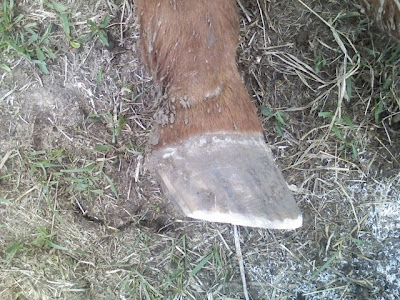

Her feet are coming along very well. I am very happy with the new growth--it is coming in at just the right angle and her soles look terrific. She is such a good girl and patiently allows me to trim her while she's laying down--it's still a bit too painful for her to stand and let me trim her, though I can get her to give me her feet long enough to clean them out--a significant improvement from when she first got here!
I forgot to get before shots, but here is the one foot I hadn't trimmed yet. You can see her soles are in great shape, obvious healthy hoof wall growth and frog growth is good--I'd like to see it a bit wider but that will come as her heels spread--they were very contracted when she got here. They look tons better now, so the frogs will soon follow.

Empress taking it easy while I trim her up. She is definitely due for a grooming session today.
Trimmed foot. I couldn't find my hoof knife, so I had to pare back the frog with the nippers as best as I could--I'll get to her frogs later this week. Notice the healthy pocket her sole makes--this is really terrific structure. She has a great shape, too, but notice how the whole foot seems to have slid forward and the large amount of space between the tip of the frog and the hoof wall. This will have to grow out, unfortunately. As you can see from the white line I have filed back a lot of the hoof wall on her toe from the top and gave her a mustang roll. This makes it easier for her to walk while waiting for her angles to correct. I wish I had taken pictures of her feet before--there is noticable improvement in her heels. We just need to get the entire structure moved back and she'll be in great condition.
Here's Hope, very concerned about what I'm doing to her friend ...
Picture of the hoof from the side. You can see she still looks very long, but I trimmed her back as far as I could go without soring her. It will take time to get her angles corrected, but you can see the mustang roll from here, as well as the new growth.
Picture with new growth indicated. You can see how it is at a different angle from the rest of the foot, which is exactly what we need to achieve. We're on the right track! :)
Friday, May 1, 2009

Tuesday, April 28, 2009
Cecilia "Sandy" Jarvis strikes again...


The poor mare pictured above was due to foal last week.
As many already are well aware, this mare was removed from Sandy Jarvis's place yesterday with the help of the local law enforcement. By the way, kudos to the Kiowa County, OK Sheriff's department! They have certainly been outstanding through this entire ordeal.
In addition, everytime I get an email I see humanity at work in seeing the horse community come together in a time of need. It is heartwarming to hear of so many people reaching out to help. Thank you so much to all those who have contributed so far!!
Just as a comparison, here is how the mare looks when she is healthy:

According to Sandy, these pictures below show a mare that is just "a little thin."

 We can guess where the money for feed is going....
Could it be going towards your new tattoos? http://www.myspace.com/diamond_j_ranch Gee, I wonder why it says she's anxious--I guess when you don't call a mare's owner back for several days because another horse looks like this in your care (again) you'd better be a little anxious...
Or, you can follow dear Sandy on Twitter: http://twitter.com/diamondjranch Seems "feeding horses" is not listed in any of the day's activities.
Feel free to check out her public blog: http://www.diamondjranch.blogspot.com/
Enuf said.....
Thursday, April 23, 2009
3-Strikes Rescue Operation
 SW Nebraska--Three Strikes Ranch, a supposed sancuary for unadoptable mustangs is now the center of a massive rescue operation. According to the owner there were once 300 horses on the place. Reports of up to 50 have been found dead and another 100+ are alive, but extremely emaciated: http://s631.photobucket.com/albums/uu39/mustanglove12/
Here are some current articles on the situation:
http://www.cjonline.com/interact/blog/aleah_mahan/2009-04-20/scores_of_neglected_mustangs_imperiled_on_nebraska_ranch_update
http://www.habitatforhorses.org/whatsnew/NEMustangs.html
Here is the rescue in charge of donations:
http://www.frontrangeequinerescue.org/
According to their website, "There is currently a serious situation at 3-Strikes Ranch in Alliance, NE. Approximately 170 mustangs have been found to be thin and in need of rehabilitation. Veterinarians and law enforcement are currently working hard to determine the cause for their condition. In the meantime, there is a great need for hay to feed these mustangs.
Front Range Equine Rescue in Larkspur, CO, will be handling the collecting of donations and purchase of the hay to help these horses.
The quickest way to help is by Paypal. The Paypal address for Front Range Equine Rescue is: donatebuy@frontrangeequinerescue.org.
If you do not have access to Paypal you can mail donations to: Front Range Equine Rescue, PO Box 307, Larkspur, CO 80118."
I will try to keep the blog updated as to the situation. This is why I am starting to truly believe that licensing for horse owners is going to be a neccessary evil in the future. It will limit all our rights to horse ownership, but I'd rather give up some rights than to have crap like this keep happening...
Subscribe to:
Posts (Atom)